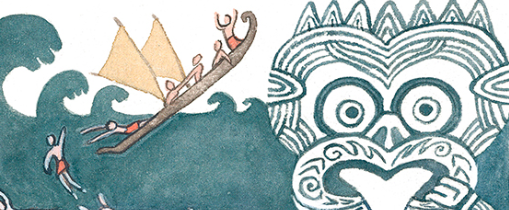
A Marakihau.
Arā hara mai rā te manu whakateka I ō ki Poneke ra!
He reo ka ongaonga I te ara nā Whakatauihu!
Nā te moni o runga rā I kawe I te riro o te whenua
I te whakahaerea ōku e te pirihimana!
He puha ka riri he puha ka rewa I te marae!
Ka whakateka tīemiemi tō kupu ki te wai tari o Waitangi ki te paewai o te rangi! Ki te whāngaromanga
Pioi ana te taiaha e Ihu i te hau moana!
ki te tūtutupō te rongo hou kura, te tatau a Apakura.
Pai mārire
You come to me the lying bird from within Wellington ( The parliament)These words are abuse at the path of the ancestor Whakatauihu!
Because of money you stole all the land
As we get managed by the policeman!
Anger erupts on the marae!
Your up and down lies get taken to the waters off Waitangi to the horizon! To the void
Let Whakatauihu brandish the taiaha with the winds from the sea!
To the red evenings the peaceful yearning and consideration of Apakura
Good peace
Political leaders return to Waitangi each year with carefully chosen words — respectful, ceremonial, often flowery. Yet the history of this country is now widely accessible and easy to understand. The realities of colonisation, dispossession and broken promises are not hidden. They can be readily ascertained by anyone willing to look.
Despite this, the major political parties are not driven by the kind of justice that such knowledge demands. Since the inception of Pākehā government, the state has largely served the interests of big business. Today, around 372 people own as much as the bottom 2.5 million in this country — a level of inequality that is fiercely defended. Both Labour and National ultimately protect this arrangement, and so we have our work cut out for us.
I often liken our struggle to that of Whakatauihu — known among some iwi as Whakatau Pōtiki — as told by the tohunga Hamiora Pio. In that account, Whakatauihu eventually avenges the death of his brother Tūhuruhuru at the request of their mother Apakura. When he burns the pā led by Tikimakaue, it is remembered in the red skies seen across the land — the tūtutupō.
I use this story as a metaphor for our own journey toward justice and peace: the “tatau a Apakura” — the considerations of Apakura. It speaks to the long memory of injustice and our moves towards balance and resolution.